Wednesday, 17 August 2011

Gilbert and Ellice Islands Postage Dues

Periodically individual used postage dues from the Gilbert and Ellice Islands can be seen for sale on eBay and other online auctions.  Complete used sets with a decidedly "philatelic" feel to them come up for sale less often.  The set of eight values was issued in August 1940, and used examples are priced at nearly double that for mint by Stanley Gibbons.  A forged Madame Joseph cancellation inscribed "POST OFFICE OCEAN ISLAND" dated "16 DE 46" can be readily found on all values of these postage dues.


The example illustrated with an indistinct postmark sold on eBay for US$14.83 on Wednesday, 17 August 2011.

Dr. J. L. Grumbridge. O.B.E., writing in Gibbons' Stamp Monthly in March 1948 gave a detailed account of the usage of postage due stamps in the Gilbert and Ellice Islands.  Dr. Grumbridge corresponded with a number of residents of the islands in the 1940's, and their attempts to find genuine usage of the stamps proved fruitless.  Efforts with deliberately underpaid covers also failed to produce usage of the postage dues.  One correspondent wrote in 1940:
Alas, your insufficiently stamped letter was not marked so, and even if it had been, I doubt if any tax would have been collected.  I have received many under-stamped letters, but have never been called on to pay tax, and I doubt if any tax has ever been collected here.
A cover was found posted from Curacao to Fanning Island in March 1944.  Underpaid and marked with a hand-stamped 'T' and manuscript '20', the postage due was paid with a normal 5d. postage stamp.  Another correspondent wrote in 1947:
Re Postage Dues.  I have never seen any used out here.  In fact I do not think they exist.  Unstamped letters were quite frequently received in war-time and I think occasionally a local scribe would write in pen or pencil that postage was due, but I have never heard of any being collected, nor has any application ever been made to me for such postage due on unstamped letters.
Eventually a postage due stamp was, however, discovered, and an attempt made to put it to the use for which it was designed:
I have managed to unearth for you a Postage Due stamp.  Our local postmaster did  not know anything about such things and has never handled any.  But I discovered our radio operator had once had a few when he was at Ocean Island.  I managed to dig one out of him, arranged for posting an unstamped letter, and for the local postmaster to affix the said postage due, and send the letter over by a policeman, to whom I promised in all good faith to pay up the penny due.  But the said policeman disappeared without waiting to collect it.
To add insult to injury, the postage due stamp had not been cancelled with the postmark.

Friday, 29 July 2011

Why Things Are

"The Earth or Globe, on which we collect stamps, is organized by the International Postal Union, which divides it up into countries. The Postal Union turns on its axis every twenty-four hours, thus creating day and night.

The principal countries of the world are Cochin-China, the Gilbert Islands, Somali Land, the Gaboon, the Cameroons, Nankipu, Johore, and Whango-Whango. Alongside of these great stamp areas are others of less importance, whose stamps are seldom if ever worth more than four cents, such as the United States, Great Britain, Canada, France, etc.

Some of these countries, however, are of importance as exercising a control over the stamps of places of the first rank. Thus, England comes into prominence as having been recognized by the Postal Union as controlling Sarawak, Uganda, Inhambane, Irac, and other great centers. Similarly, the Philippine Islands, after centuries of misgovernment were transferred by the Postal Union to the United States and Portugal. The Portuguese, of no account in themselves, they are known, all over the world, as issuing stamps of Lorenço Marques.

The Stamp Book can teach us, among other things, the reason and origin of government and how it comes into being. Whenever a part of the earth contains a sufficient number of people to need stamps, the people all get together and join in forming a government the purpose of which is to issue stamps.

If the stamps are to have a man's head as one design, the country is placed under a king, the person selected for the king having the kind of features needed for a stamp.  The British royal family makes such excellent stamps that it is thought that they will be kept at the head of Great Britain for a long time to come.  On the other hand, the Emperor of Brazil had to be deposed in 1889, his whiskers being too large to go through the post.

In other countries, it is decided that the Goddess of Liberty has a more beautiful face than a king, and so these countries are called republics and they elect a new stamp every few years. "

From Stephen Leacock's Short Circuits (1938)

Wednesday, 13 July 2011

Government of South Sudan releases first stamps

The newly-independent Government of South Sudan has announced the release of the country's first postage stamps.


According to Brigadier General (retired) Elijah Biar Kuol, the Director General for Administration and Finance in the Ministry of Telecommunications and Postal Services, some 100,000 copies of the stamps have already been distributed to all the states of South Sudan.

He said the focus will be in the rural areas where more than 80 percent of the citizens of the Republic of South Sudan live.


South Sudan has already announced its intention to join the Commonwealth.

Saturday, 9 July 2011

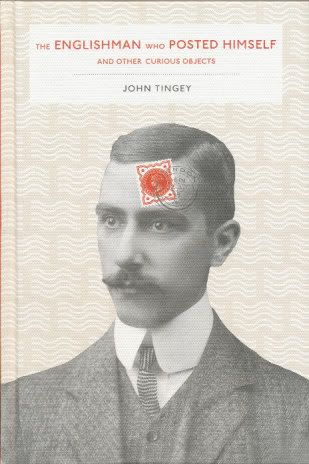
The Englishman who posted himself and other curious objects

The Englishman who posted himself and other curious objects by John Tingey, published by Princeton Architectural Press, New York, 2010.


In 1898 Willie Reginald Bray purchased from his local post office for 6d. a copy of the Post Office Guide, a reference book published by the British Post Office, detailing its costs, services and regulations.  This simple acquisition resulted in Bray unleashing a torrent of tests and challenges for the Post Office.

Where regulations stipulated that “letters should be clearly and legibly addressed” and “all letters must be delivered as addressed”, Bray responded by posting articles addressed with riddles, rhymes and pictures.  He wrote a card addressed to “Any Resident of London” – it was returned to Bray “insufficiently addressed” and surcharged 1d. 

One card he addressed to “The resident” with a picture of a house in Bournemouth, Hampshire.  The article was returned undelivered with a rhyme written by a postman:

“Pursuing this game we hope there are not many,
However for your hobby you will have to pay a penny.”

Bray also had a great deal of fun posting a wide range of articles that were not expressly prohibited by the Post Office.  He posted his dog, as well as a single onion, sea weed, and famously, himself.  Posting people was permitted, remarkably, under the regulations:
“A person may also be conducted by Express Messenger to any address on payment of the mileage charge.”
No proof survived of Bray’s first mailing of himself in 1900, so in 1903 he re-mailed himself using the Registered Mail service, obtaining a certificate of registration as evidence!  In 1932 Bray posted himself for the third and last time, re-enacting the scene as a publicity stunt.  He was delivered by two postmen, with a photographer to record the event.
In 1899 Bray began to collect autographs, commencing with a request to President Kruger of the Transvaal for his signature.  Bray quickly shifted his focus to collecting autographs, and by 1906 Bray claimed that he had the world’s largest autograph collection.  He nicknamed himself the “Autograph King”, and sought the signatures of celebrities, statesmen, military commanders, movie actors, even criminals – in short, anyone who had been or was in the news of the day.
Bray died in 1939, and his collection sold and dispersed in the 1950’s.  The vast collection developed by Bray is remarkable for the fact that he created every article within it.  He addressed or produced every article he posted and returned to him for his collection.  His postal curiosities are today highly collectable, and the intriguing story of one man’s collection is recounted beautifully in this book written by John Tingey.

Friday, 8 July 2011

Overland Mail Baghdad-Haifa

In the wake of World War One, two New Zealand soldiers who had served in Palestine recognised the need for an efficient overland transport service between Mesopotamia and the Mediterranean.  The brothers, Gerald and Norman Nairn, founded the Nairn Transport Company in 1923.  Their area of operations was the vast Syrian Desert, with passenger, freight and mail services offered between Baghdad in Iraq and Haifa in Palestine.  The route passed through Beirut in Lebanon and Damascus is Syria.

The administrations of Palestine, Lebanon, Syria and Iraq welcomed the brothers’ company with enthusiasm, and after successful runs with passenger coaches between Baghdad and Beirut, postal contracts were signed.  Nairn Transport Company provided acceptance of mail at their offices, as well as collection of mail from departure post offices and delivery to the post office upon arrival at the destination.  Nairn’s charges for these services were paid by affixing additional postage stamps to envelopes.  The four countries in which Nairn’s operated agreed that additional postage should be charged for the overland service.  These charges were abolished for letters in 1929, but continued for parcels.

The weekly service commenced in October 1923, and the earliest known date for a cover is 23rd October 1923.

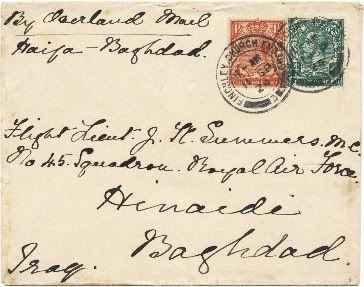
In Iraq postage for an ordinary foreign letter was normally 3 annas, whereas a letter routed via overland mail Baghdad-Haifa required 6 annas.   In Palestine postage and overland mail fee amounted to 13 mils.  Postal authorities outside the four countries serviced by Nairn’s also charged additional postage.  The cover above has 5½d. prepaid, which was the correct franking for a letter under 1 oz.  The UK foreign letter rate up to 1 oz. was 2½d. and the surcharge for use of the overland mail was 3d.  It was postmarked in Great Britain on 11 September 1924 with arrival backstamp in Baghdad on 20 September 1924.  The cover is also correctly inscribed in manuscript with the accepted wording 'By Overland Mail Haifa-Baghdad'.

The first vehicles used by the brothers were 75 hp buses imported from the United States.  The vehicles were luxuriously appointed for the long journey over the desert.  They were later fitted with steel plate and iron bars.  This was to provide protection for passengers from bandits and snipers who had proven troublesome to the service.  From 1927 the buses were replaced by large six-wheeled luxury coaches. 

By 1933 the political circumstances in the Middle East had changed considerably.  Growing movements for full independence, particularly in Iraq and Syria, saw the postal administrations of these countries cancel their contracts with the Nairns.  By the end of 1934 the overland mail had ceased, although this had little impact on the company as their passenger business continued to grow.

Thursday, 23 June 2011

India Birds of Prey error sells for £11,500


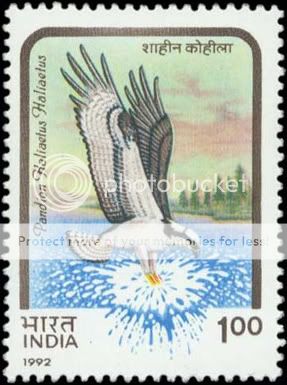
The heading says it all really. An example of the stamp pictured, India SG 1525a, error of value, sold for £11,500 at Stanley Gibbons' 15 June 2011 sale in London.

The stamp is catalogued by Stanley Gibbons at a mere £1,000. A quite spectacular realisation for a modern error.

The example illustrated here was sold by Grosvenor's at auction for £2,100 in December 2009.

In examples of the 1992 India Year Pack of commemorative stamps, the lowest value of the Birds of Prey set was discovered to be a 1 r. value, instead of 2 r. as generally issued. The 1 r. value also included the species description for the 6 r. value from the same set.

It appears that it was intended that the lowest value in the set was to be 1 r., but when the inscription error was discovered after the stamps were printed, it was decided to reprint with a corrected inscription and increased value of 2 r. In the meantime, some of the 1 r. value errors had already been placed in a number of 1992 Year Packs.

By 1998, three of the errors had been discovered in Year Packs. It appears that all other 1 r. stamps were destroyed by the Indian Post Office.

Thursday, 16 June 2011

Tristan da Cunha taxed item

Tristan da Cunha 1937 Taxed cover

A post office was first opened on the South Atlantic island of Tristan da Cunha on 1 January 1952. Between 1908 and 1952 there were no postal arrangements for Tristan da Cunha. It has been stated that:
For all practical purposes, prior to 1952 the islanders had neither money nor stamps, and letters were therefore almost invariably posted without stamps, and hence they were taxed at double the foreign letter rate on delivery.
This cover was posted on Tristan da Cunha, date unknown. It arrived in Cape Town on 8 March 1937, where it received the Cape Town Paquebot cancellation. The letter also received the 1d. surcharge in Cape Town, indicating 1d postage due. From Cape Town it was sent to its destination in Pretoria, where it received the UNPAID UNBETAAL cachet. When the unpaid item was collected by the addressee, and the 1d postage due paid, the cover was franked with the 1d postage due and duly cancelled with the PRETORIA 11 MAR 37 postmark.